Spring Beekeeping Workshop

Spring Beekeeping Workshop
Demonstration Hive

Thursday, August 9, 2012

Edible Wild Plant - Purslane (Portulaca oleracea)

Purslane (also known in some places as Pusley) is a common weed of gardens.  Easy to identify, the plant grows sprawling over the ground with prostrate, somewhat fleshy, stems.  There is variation between plants growing in different regions, however, mine have reddish suculent stems that are filled with a clear juicy sap.  The leaves grow in a rosette and are small and also somewhat fleshy, or leathery.


As you can see in this photo taken in my garden, the leaves are less than one inch wide and vary in length up to about one and half inches.

There is quite a bit of information about the nutritional value of this plant on the internet.  Authors, Thomas S. Elias and Peter A. Dykeman state that purslane is "One of the best wild shoots cooked or in salad" and that it is "high in iron" (Edible Wild Plants:A North American Field Guide To Over 200 Natural Foods, Sterling, 1982).

Both stems and leaves are gathered for food preparation.  The more mature stems are usually cooked, or preserved by pickling.  Tender leaves and stems may be eaten raw.  Seeds are collected, dried, winnowed and ground for use as an addition to baked goods.  All parts of the plant may be blanched and frozen for keeping through the year.

I have only used the leaves and stems fresh, so far.  Here is a simple salad that I make using purslane and also the tight, immature flower buds of garlic chives:

Harvest and clean the purslane stems and flowers.  Break the stems into small pieces.  Make sure to examine the leaf rosettes carefully for little insects that may be hiding inside the leaf rosettes.  To be sure to clean properly, immerse the plant parts in a salt water bath for a few minutes.  Insects will be killed and usually rise to the surface of the water.  I still recommend examining the plants carefully to remove any foreign matter.  Rinse twice in cold water.

Place all the leaves and stems in a salad bowl and toss in a handful of garlic chive flower buds.


You may also add any other mild-tasting salad vegetable you desire.  Cucumber is a good choice, also cooked kohlrabi or anything else that is mild.  The purslane is quite strong tasting and acidic (somewhat lemony) and the garlic chive flowers are strong also with - guess what? a garlicky taste!  So, cucumer is a good base for those flavors.

I make a dressing of one third olive oil, two thirds apple cider vinegar, with salt and pepper. Whisk together briefly to make an emulsion and toss into the salad.  It's a very simple and fresh tasting salad for a summer evening.

Tuesday, August 7, 2012

Edible Wild Plants - Lindera benzoin

At a recent class here at the Center for Sustainable Living, participants tasted drinks and foods made from wild plants that are growing prolifically around this region, are easy to find and identify, and are not easily confused with anything that will make you sick.

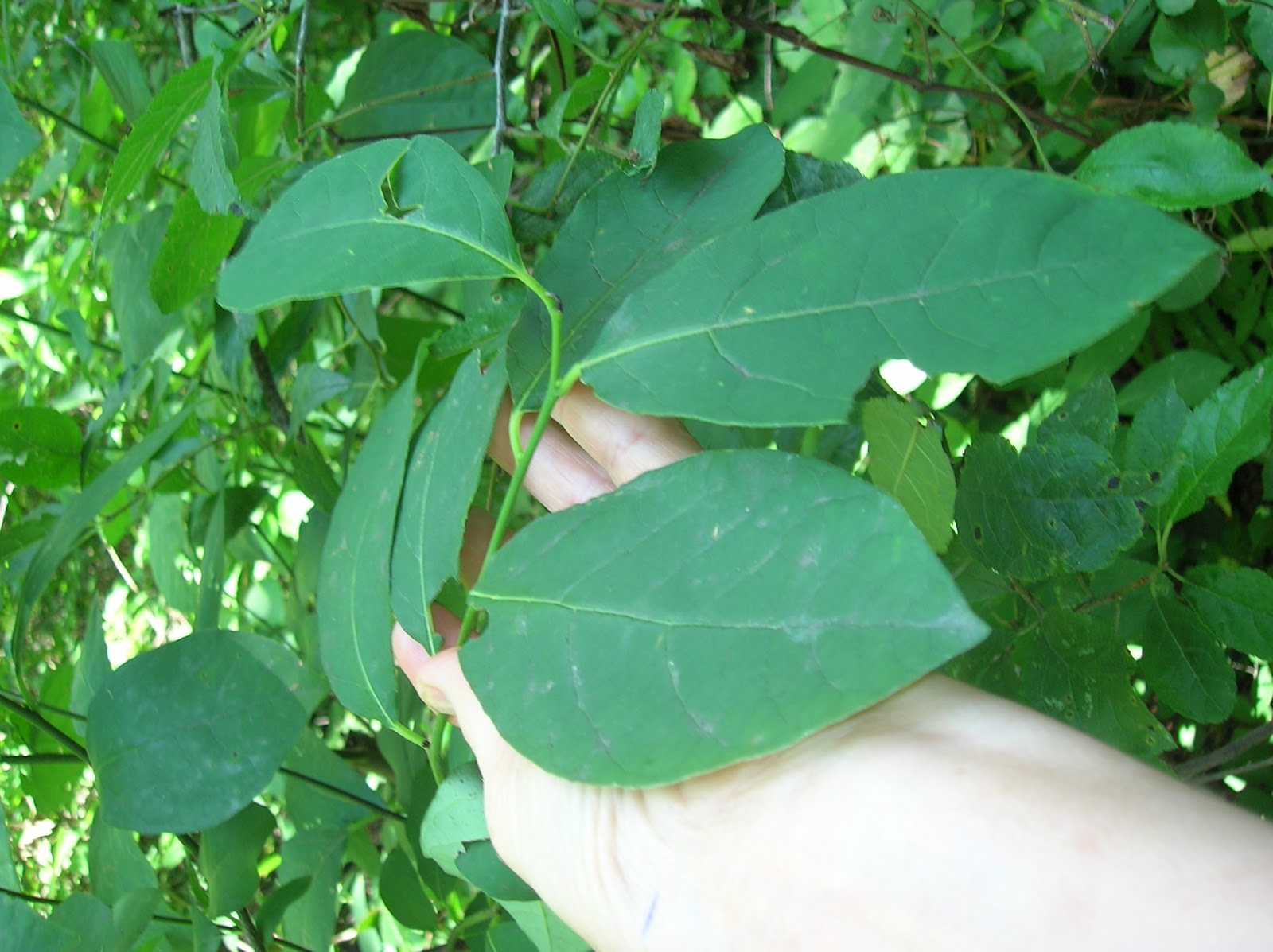
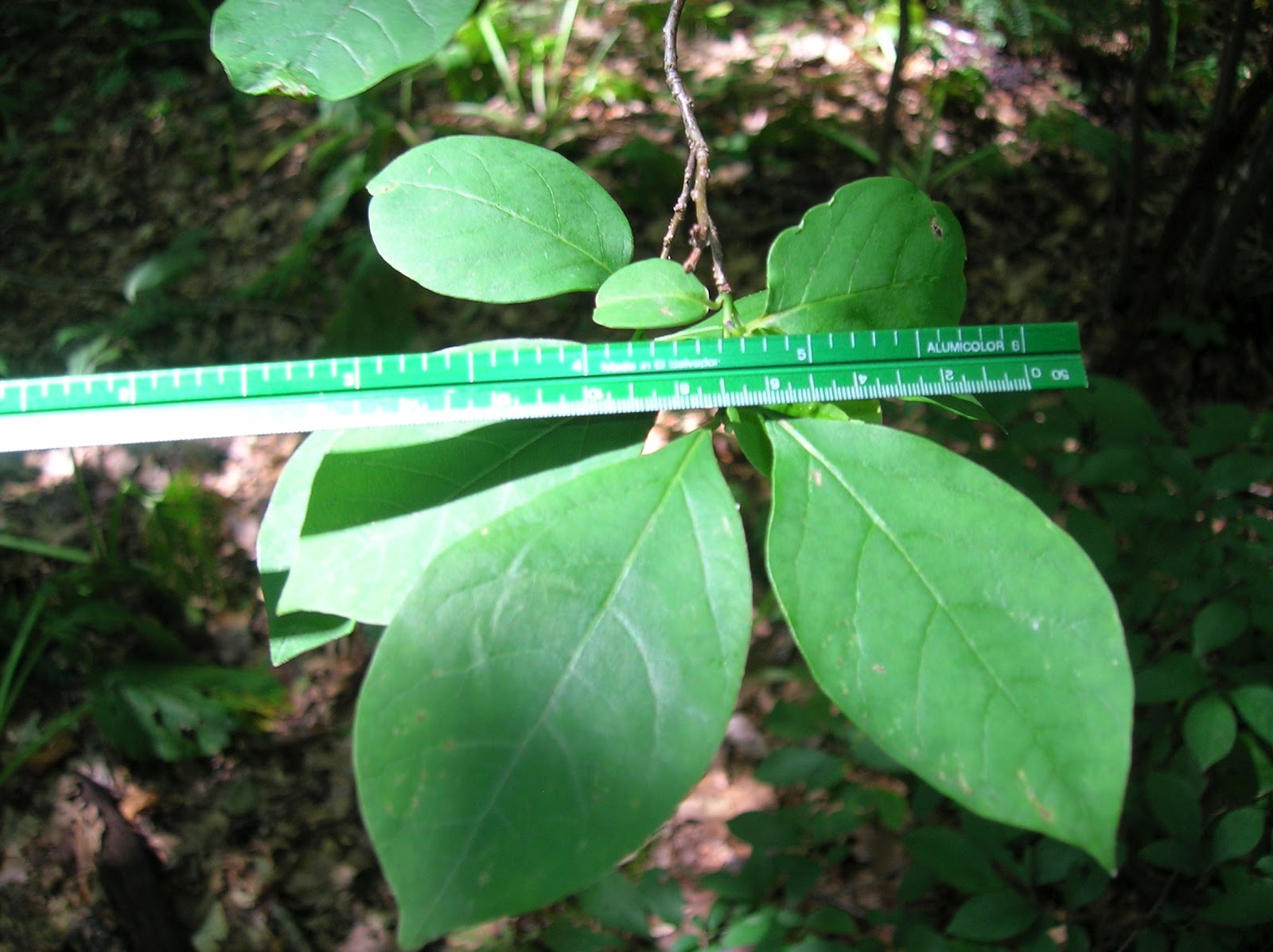
One of my favorite wild shrubs is the Spicebush (Lindera benzoin).  A medium sized shrub that grows profusely in shaded wetlands and moist shady woods, Spicebush has an irregular shape, in other words not a uniform or neat shape, but spreads out or up in different ways, usually under taller trees which, I think, contribute to its growth habits.  It grows into the spaces left by the bigger trees.  The bark of the main stem and twigs is rough and has raised whitish dots called lenticels that are noticeable to the naked eye.  At this time of year (August), bright green, pointed berries about 1cm long, are growing along the stems.

All parts of this plant are strongly aromatic.  A spicy, citrusy smell is immediately evident when the leaves are rubbed, the twigs or berries are scratched or broken.  This useful, edible plant makes a delicious, slightly sweet, slightly astringent infusion which I've been drinking liberally during the extremely hot, humid days we've been experiencing recently.  The leaves are a bit tough at this time of year to be eaten as a raw salad green, but probably can when young and delicate in the spring.  They also could be shredded and steamed and added to a mix of other cooked green leaves.  The berries are useful as a spicing agent.  I suggest drying them first in either a low oven, out in the sun, or in a food dehydrator.  When thoroughly dry, grind them in a spice or coffee grinder and store in glass jars.  Use as you would allspice or other pungent, sharp-tasting seasoning.

To make the tea, gather an armful of stems with leaves, any time from spring to fall.  Make sure toWASH all plant parts carefully, inspecting the leaf surfaces and especially the lower sides where plant eating insects like to hide.  I usually double, or triple wash all plant material whether from the garden or the wild.  Pour the water around plants instead of wasting it down the drain.

When clean, break the twigs, ripping the bark as you snap them to expose more of the aromatic interior.  Tear the leaves roughly.  Throw it all into a large pot of  boiling water.  Bring back to the boil.  Turn off the burner.  Using tongs or wooden spoon, dunk the spicebush under the water.  Cover the pot and leave it to sit for at least 2 hours.  The longer the infusion, the better the taste.

Strain the leaves and twigs through a colander, catching the liquid of course.  Allow to cool and decant into glass jars or insulated thermos.  Refrigerate and drink over ice.

The "tea" is fine just as it is, but you may choose to sweeten it a little with your favorite sweetener - agave, honey, stevia, or plain sugar.  If you do choose to sweeten it, add the sweetener when the tea is still hot. The flavor is delicate, but not bland.  I would love to hear how you like this unusual beverage.

Monday, June 18, 2012

Wendell Berry's Rule #17

As always, with thanks to visionary writer, Wendell Berry who wrote these provocative "Rules for a Sustainable Community" that are presented here as excerpted from the poster of the "Rules" published by Yes! Magazine:

"A sustainable rural economy will be dependent on urban consumers loyal to local products.  Therefore, we are talking about an economy that will always be more cooperative than competitive."

So, we come to the end of the 17 rules.  With this last one, I see that Mr. Berry is stressing the connection between different communities and different people in a region.  It is the rare person or family that can make it completely on their own.  I, for one, wouldn't want to.  I like people (usually!) and I like the idea of an economy that is based on things that can be grown, raised or made in rural areas supporting people in cities and suburbs while those people engage in activities that create value-added enhancements to the rural lifestyle.  Regional micro-financing of small businesses, will depend, in the future, on everyone re-investing in their own communities and not so much on the global mega-corporations.

Explore sustainable investing through mutual funds such as credit unions like the Permaculture Credit Union (www.pcuonline.org) which will provide capital for small projects such as solar systems, energy efficiency upgrades or rainwater catchment systems.  Or check out Green Century Funds, a mutual fund which considers the actions and ethics of companies selected for the fund.

PLEASE NOTE, I am not a financial planner and cannot specifically recommend any particular fund or credit union.  My objective here is to raise the IDEA of sustainable financing and investment and NOT to give a financial recommendation.

In this final Rule #17, we see that a sustainable community cannot operate in a vacuum.  A sustainable economy must be one where we are interdependent on one another, our neighbors and our neighboring communities, first, before become dependent on other parts of the world.

Sunday, June 17, 2012

Wendell Berry's Rule #16


As always, with thanks to visionary writer, Wendell Berry who wrote these provocative "Rules for a Sustainable Community" that are presented here as excerpted from the poster of the "Rules" published by Yes! Magazine:

"A rural community should always be acquainted with, and complexly connected with, community-minded people in nearby towns and cities."

Just as it won't be worthwhile if our own households are the only sustainable ones in our community (after all, if our neighbors are hurting, suffering, struggling, how will we in good conscience live happily in our sustainable homesteads?), we must reach out to neighboring communities and work together to create large oases of sustainability that are resilient to whatever comes from climate change, oil shortages, general natural resource shortages, weird weather, whatever.

Monday, June 11, 2012

Wendell Berry's Rule #15


As always, with thanks to visionary writer, Wendell Berry who wrote these provocative "Rules for a Sustainable Community" that are presented here as excerpted from the poster of the "Rules" published by Yes! Magazine:

"Always be aware of the economic value of neighborly acts.  In our time the costs of living are greatly increased by the loss of neighborhood, leaving people to face their calamities alone."

I believe people in my little town would say we are doing pretty well on this matter.  However, I think it is an important topic to raise especially with more frequent and more severe storms happening.   Wouldn't it be a good idea to know exactly who is living alone, may have mobility or other health issues and could be very isolated in a crisis.  In a small town like mine, there are many people already thinking about these issues - the volunteer fire and ambulance crews, for example, and church members, the senior committee members and others working in various capacities at town hall.

But, perhaps, a simple neighborly act is all that is needed, sometimes, to help a lonely or confused neighbor out of a tough spot.  It's what extended families always do for each other, but nowadays, many people live far from their families and friends and neighbors become their support system.

Sunday, June 10, 2012

Wendell Berry's Rule #14

As always, with thanks to visionary writer, Wendell Berry who wrote these provocative "Rules for a Sustainable Community" that are presented here as excerpted from the poster of the "Rules" published by Yes! Magazine:

"Look into the possible uses of local currency, community-funded loan programs, systems of barter, and the like."

Wouldn't it be great if you could exchange your product or service for what you needed, from someone in your own community, without using regular money?  Well, the idea is springing up all over the place.  The nearest example to me is in the Bershires of western Massachusetts.  Go to this website below for lots of information on what people are doing and how it all works.

http://www.berkshares.org/

Also, here's a good book reference on the subject:

"Local Dollars, Local Sense: How to Shift Your Money from Wall Street to Main Street and Achieve Real Prosperity," by Michael Shuman (Chelsea Green). 

It's not so much about direct barter as about looking for sustainable and local ways to invest.

Saturday, June 9, 2012

Wendell Berry's Rule #13


As always, with thanks to visionary writer, Wendell Berry who wrote these provocative "Rules for a Sustainable Community" that are presented here as excerpted from the poster of the "Rules" published by Yes! Magazine:

Account for costs now conventionally hidden or "externalized."  Whenever possible, these costs must be debited against monetary income.

What does this mean? How are costs hidden in an economic sense?

The easiest way to think of this is to think of a manufactured product that comes from raw materials that are shipped, probably from one country to another, to a manufacturing plant.  In accountancy, the cost to the environment of the planet of extracting the raw materials, is not taken into consideration.  So, for example, the effects on the land, the air, the water and ultimately to the people in nearby communities and the world at large, of clear cutting forests or strip mining or mountaintop mining, which are extreme examples of negatives effects of materials acquisition, are not figured into the cost of production.

This means that, although there is a huge cost in terms of health, safety and welfare of all living beings on the planet by these actions, the monetary cost to repair (if that's even possible) is put off to some indeterminate time in the future to be borne by future generations.

Eating wild harvested fish that are being caught in vast numbers that boggle the mind, contributes to the profit of fishing corporations or even individual fishing families, but the crash of fish species populations in the oceans lead to devastating disruptions of the oceanic ecosystem with far reaching results for ocean health and therefore climate and biological health of the planet.

None of these types of costs are shown on the debit side of a corporations bookkeeping ledgers. What Rule 13 is asking is to have these costs clearly shown and the profits of a corporation should reflect these costs in an honest way so that profits made from the product should be reduced accordingly to repair the damage created by the companies activities.

By buying locally produced goods and foods we can more easily see the results of the businesses actions and choose whether the products meets our needs of living sustainably and in harmony with our belief that the human race must choose options that do not harm the planet so that we all may live (the human race in concert with other creatures).